
Juba/Nairobi, 19 May 2026 – Indiscriminate attacks on civilians and civilian structures – including bombing hospitals – forced recruitment, sexual violence, access constraints and shrinking humanitarian space are realities for people in South Sudan, as described by Médecins Sans Frontières (MSF) in their report on escalating violence in the country, “They Killed Them While We Were Running”. The report details that a total of 12 attacks on MSF staff and facilities left an estimated 762,000 people without the access to healthcare between January 2025 and April 2026.
MSF calls on the government of South Sudan, the Sudan’s People Liberation Army – In Opposition (SPLA-IO), and all parties to the conflict to protect and respect civilians and civilian infrastructure. Civilians and civilian infrastructure, including healthcare, must never be targeted; direct attacks against them constitute serious violations of international humanitarian law (IHL). Under IHL, all parties have an obligation to respect and protect civilians and to avoid the use of indiscriminate or disproportionate force, including the use of airstrikes and incendiary weapons in populated areas.
“I ran away with my child. I could see the village burning from afar,” says a woman who was displaced and treated at an MSF facility in Chuil, Jonglei state. “They set houses on fire. They burned my grandmother inside the tukul [traditional house]. The elderly stayed behind, they could not run with us. They killed the elders.”
Both targeted and indiscriminate attacks conducted by the government and opposition forces and other armed actors are increasingly harming people and undermining access to lifesaving care. Since January 2025, MSF treated an average of 16 people per day for violence-related injuries, across six states – Jonglei, Upper Nile, Central Equatoria, Lakes, Warrap, and Western Equatoria – and two administrative areas, Abyei and Greater Pibor.
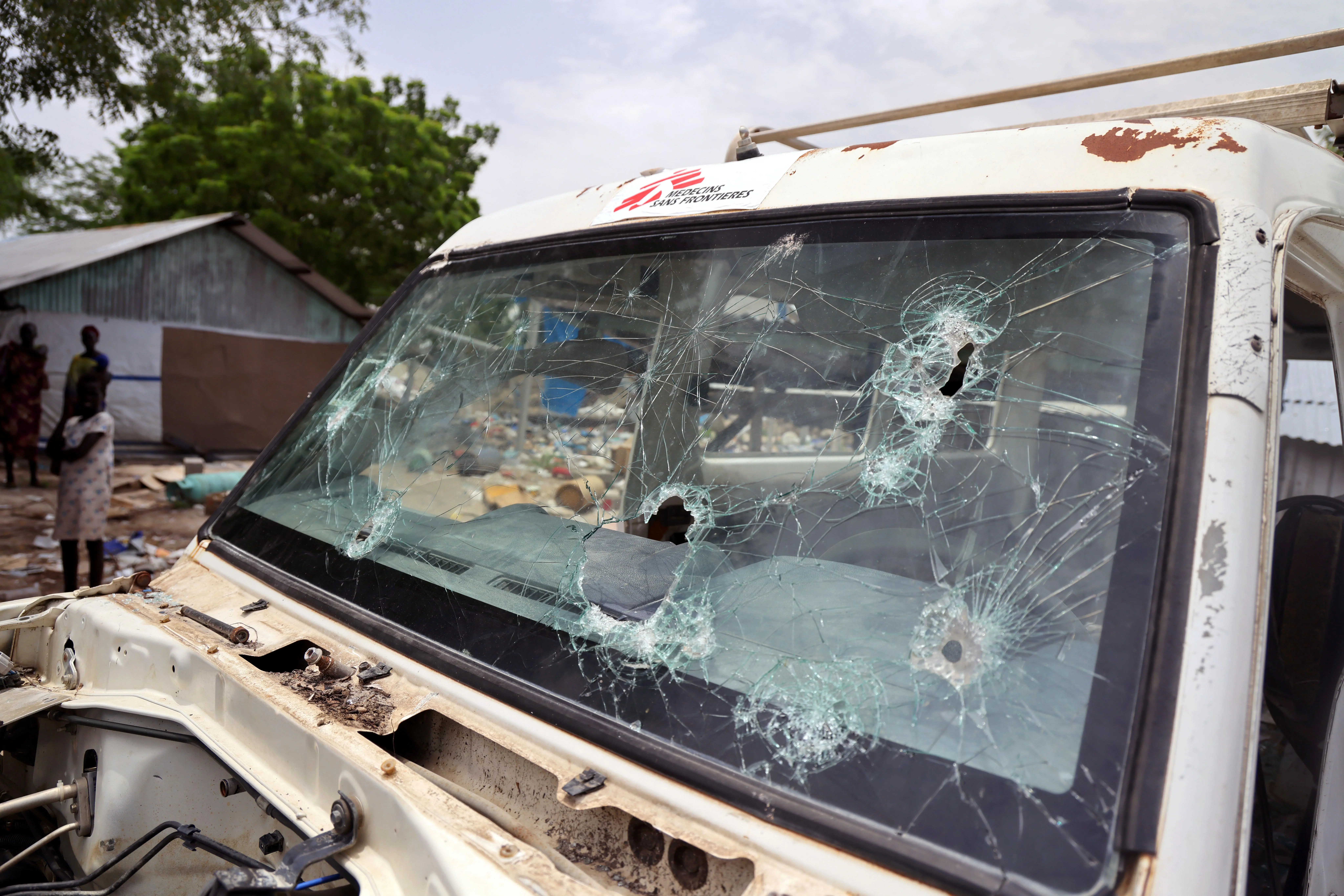
“Across these areas, civilians are facing airstrikes and ground attacks, forced recruitment, abductions, and widespread sexual and gender-based violence [SGBV],” says Zakaria Mwatia, MSF head of mission in South Sudan. “Populated towns and villages are being hit, resulting in civilian casualties, mass displacement, and the destruction of civilian infrastructure.”
The impact of violence is evident in MSF’s medical data and through the fact that 138 air strikes occurred in the country during 2025, compared to only two in 2024. In 2025, MSF treated 6,095 people for violence-related injuries, including gunshot wounds, blast injuries and SGBV, compared with 4,765 people in 2024. Treatment of gunshot wounds alone increased by 77 per cent compared with 2024. From January to April 2026, MSF already treated over 1,800 people wounded by violence, including 885 survivors of SGBV, highlighting the accelerating toll on civilians.
“On Friday night she had been gang raped by a group of men in Yei,” says an MSF staff member speaking about a patient at the Yei civil hospital in Central Equatoria state in March 2026. “She did not know by how many. She came to us for treatment. After the treatment, her grandmother took her to the village, as she thought that she would be safe there. On the next Monday, she went to collect firewood alone. Then, she was raped again by an unidentified armed man. She was back to our clinic on Tuesday.”
Healthcare has not been spared. Since January 2025, MSF has experienced 12 attacks on its staff and health facilities, including abductions and looting. The MSF-supported hospital in Old Fangak was deliberately bombed by the government forces in May 2025. MSF’s Lankien hospital was also bombarded by the same forces in February 2026. Facilities in Ulang, Pieri and Akobo were looted in separate incidents by unknown assailants. At the same time, humanitarian space is shrinking to an alarming degree.
“General insecurity, access denials, and the instrumentalisation of aid are increasingly preventing humanitarian organisations from reaching people with the greatest needs,” adds Mwatia. “MSF has observed a troubling pattern of access blockages, and evacuation orders directed at civilians and humanitarian actors.”
Humanitarian assistance is also being used as a tool for military and political objectives by all parties to the conflict. Attempts to force NGOs to relocate aid to or away from certain areas are depriving entire communities – particularly in opposition held areas in Jonglei and Upper Nile – of lifesaving assistance and preventing an adequate humanitarian response. Civilians also suffer from forced displacement, immediate and long-term physical harm, increased risk of malnutrition and disease, heightened mental health needs, and diminished livelihoods. The long journeys that people makes without consistent access to food and water, and harsh living conditions, have increased their vulnerability, especially when combined with a limited humanitarian response and disrupted essential nutrition supplies.

MSF reiterates that civilians, healthcare workers, and humanitarian organisations must be protected at all times, and that humanitarian access must be unhindered so that assistance can reach all people in need, wherever they are.
MSF has been present in South Sudan since 1983, and it remains one of MSF’s largest countries of operations globally. Since early 2025, fighting has intensified across the country, pitting government forces, the South Sudan People's Defence Forces (SSPDF) and their allies – including the Uganda People's defence forces (UPDF) – against a fragmented coalition of opposition groups, including the SPLA-IO, the National Salvation Front (NAS), the Nuer White Army and allied militias. The conflict is not a simple two-sided rivalry; it is a multi-party war with shifting allegiances, that is deeply fractured along ethnic, regional, and political lines.